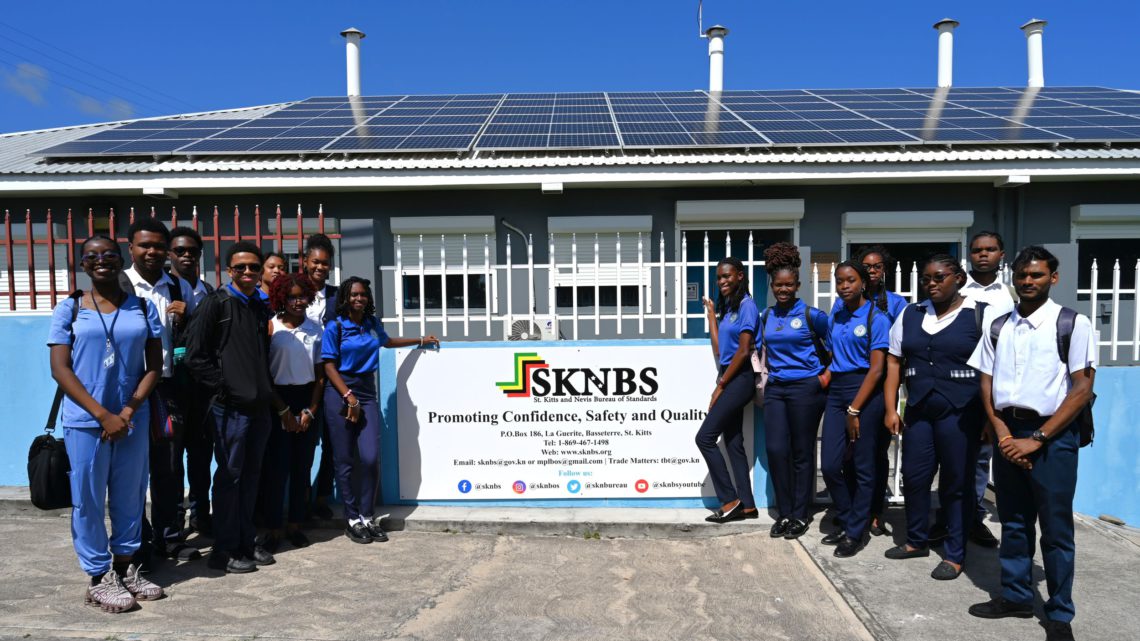
A group of second and third year students from the CAPE Chemistry Unit 2 class at the Clarence Fitzroy Bryant College (CFBC) visited the St. Kitts and Nevis Bureau of Standards and its Multipurpose Laboratories on Friday, February 13, 2026, for an educational tour of the facility’s advanced laboratory equipment and services.
The visit formed part of the students’ ongoing academic development and exposure to real-world scientific applications. The group had the opportunity to observe and learn about specialised testing instruments and procedures used to ensure quality and safety standards within St. Kitts and Nevis.
The students recently completed coursework in UV-Visible (UV-Vis) spectrophotometry and mass spectrometry, making the tour particularly timely. Seeing the equipment in operation allowed them to connect theoretical knowledge from the classroom to practical laboratory applications.
Lab Technician at CFBC, Blessings Joseph, expressed pride in the students’ participation during the visit.
“I was proud to see my students answer questions confidently, and I’m grateful that we had the opportunity to introduce them to such impressive machinery. I was also happy to see them asking thoughtful questions; it showed that they were curious and engaged in what they were being taught.”
The tour included demonstrations and explanations of how laboratory analyses support national standards, product testing, and regulatory compliance across various sectors.
Director of the Bureau, Stuart LaPlace, underscored the importance of exposing young people to scientific and technical careers.
“Engaging students at this stage of their academic journey is critical. When they can see and interact with the equipment and processes firsthand, it broadens their understanding of the role science plays in national development. We are always pleased to open our doors to future engineers, medical professionals, and scientists.”
The Bureau continues to welcome educational institutions seeking to provide students with hands-on exposure to quality infrastructure, laboratory science, and standards development. Such initiatives strengthen the link between classroom learning and national industry needs while inspiring the next generation of professionals in science and technology.
-End-